Monday, September 16, 2013

Race Report: 2013 ITU Sprint Triathlon World Championships- Keep Calm, Carry On

There were plenty of emotions going into this race.  It was the biggest race of my career, physically on the Olympic stage, plenty of people were watching from London and at home, I had been through a serious health scare, and I had trained hard for this one day.  It was also the last one.  Just seeing the finish chute or thinking about the situation made me choke up.

I was also keenly aware I had a job to do.  I needed to execute a smart race, one that was based on my training, and one that was flexible.  No two races are the same.  Things happen with the competition, conditions, equipment, or other outside forces that necessitate decisions. Even though I tried to address everything ahead of time, I knew something would come up.  In London there are T-shirts that say, "Keep Calm, Carry On."  That would prove to be very appropriate.

Race day arrived with overcast skies and a threat of light rain.  My morning schedule went off without a hitch, including a 15 minute swim and 15 minute bike at a healthclub.  I had a peaceful walk through Hyde Park and arrived at transition at 7:00 to set up and check on my bike.  For better (my vote) or worse, organizers don't allow anything other than what is essential for the race.  No towels, bags, nothing.

My main concern for the race, as it always is, is a flat on the bike.  I have never flatted in a race, and frankly, am not the swiftest with changing a tube.  However there was no CO2 available anywhere, so there was no sense in bringing any other tube changing equipment.  When I asked others, they just said they would drop out.  Given the short race, stopping to fix a flat would simply take too much time.  I felt like screaming, "That is NOT an option for me!"  On top of that, the roads are anything but smooth.  It was described as riding on rice cakes.

Then another, more important issue arose.  The light rain was making the roads slick, and I talked with several people who had already see crashes on the very technical course.  That could ruin a day.  Main goal for the bike...stay upright.  (The next day I heard there were 40 crashes in our race that included 2,150+ athletes.)

My overall goals for the race were to execute well and have fun.  Having fun in a race helps you relax which helps the body flow more smoothly, which is faster.

After experiencing Wednesday's swim start in the Aquathlon in which I started far left and 1) got pummelled, and 2) went out way too hard, I decided to start as far right as possible. This would allow me to get clear if I needed to, and allow me to set my own pace.  As an aside, it's funny how people start triathlons at full speed, yet swimmers in a 500 don't.  This swim was 750m, so I treated as such.  Perhaps triathletes could learn something from us swimmers. Starting positions were determined simply by the order in which we walked out onto the pontoon.  So I let all of the other Type As go first and only had one person to my right.  If it was a longer swim from that position, the difference was minimal.

At the horn I put in about 25m hard, saw I was clear of at least the one guy to my right, then settled into a sustainable pace.  As we approached the first turn buoy and the pack came together, I was pleased to see I was in 4th (the wave had 60, as did the wave 5 minutes earlier, also our age group).  For a minute or two I felt a minor draft, then the gap to the first three stretched out a bit too much.  At about the two-thirds point, the gap had grown just enough for...What??!!..  Two massive white swans swam right across my path.  I wonder what they thought of all the commotion.  Too funny.
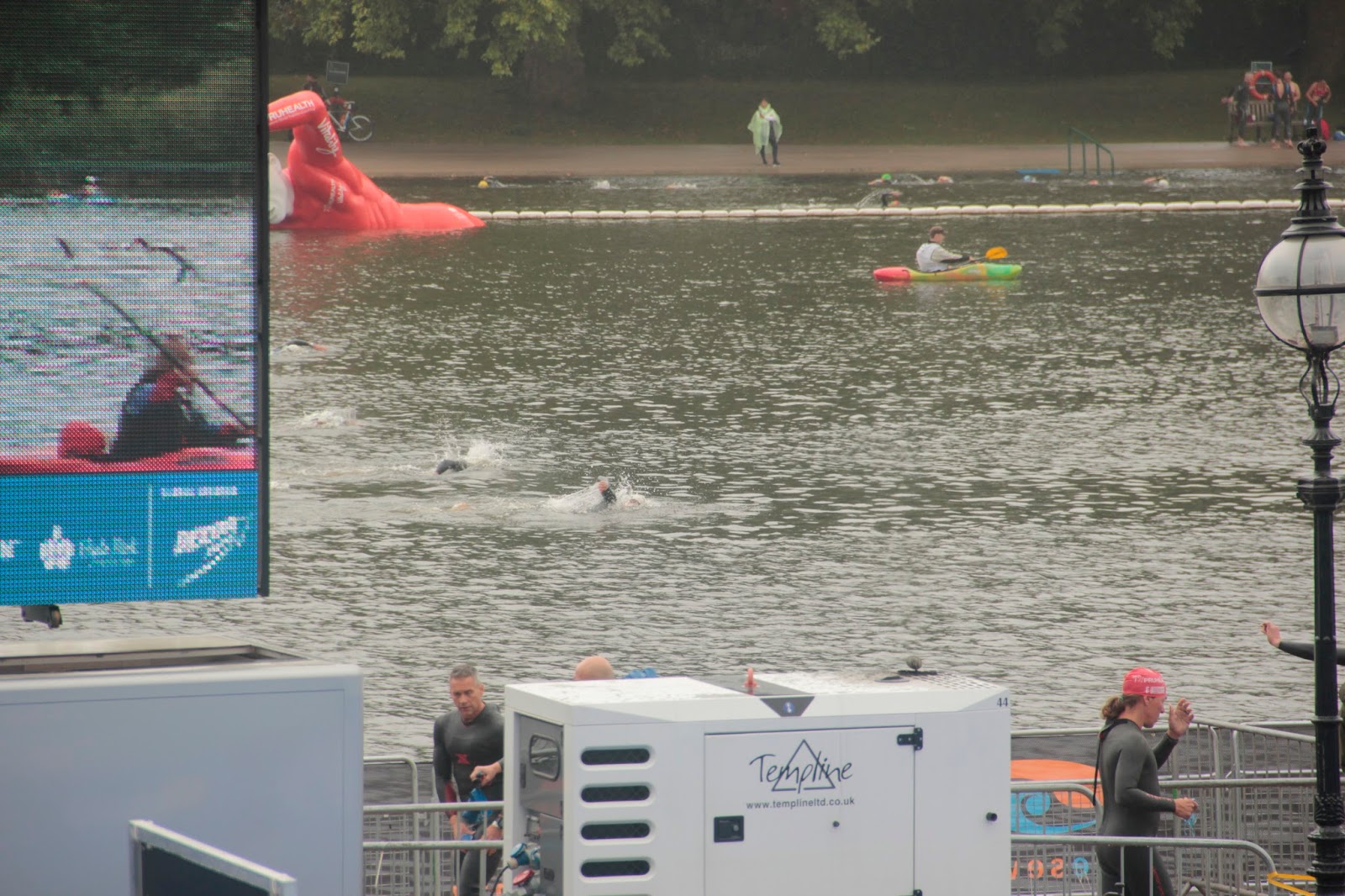

I am to the far right, closest to shore.


I finished the swim without anyone passing me, and incredibly, no one as much as laid a finger on me the entire time.  I ended up 5/113 in the AG in a time of 10:35 while the fastest swim was 10:04.  I call that perfect execution.

Both transitions took forever.  It was a long run to the area, then we had to wind our way through the massive maze.  I put more effort into both T1 and T2 than normal, but my times still were fair at best- 3:35 and 3:15 vs best times of 2:43 and 2:40.  I'm accustomed to being near the top in transitions, but this level of competition is completely different.

The bike course went out about 1/2 mile, then began three out-and-backs in the shape of a "C."  Given the slick roads, I knew the corners and 180 degree turns would be slow, so I was ready for about 25 accelerations- in other words, an interval workout.  I can do that.  That's what I've done in the pool my whole life.

Upon entering the "C," it became obvious that this would be a very crowded course, only making things more difficult.  Fortunately, much of the road was wide enough to go three wide.  The first section, about 3/4 of a mile long, was a straight shot and a bit uphill.  Thinking there would be plenty of slower sections, I decided to blast this one, and comfortably sustained 380 watts.

Then came a right hand turn, the start of about 5 turns in the span of 1/2 mile, including a brutal, sloping S-turn.  To make matters worse, the road sloped to the right for the left hand curve of the "S."  I think this is where most of the crashes happened.  Nick told me he saw people sliding 30 feet on the pavement.  On top of that, there were multiple raised crosswalks with sharp, cobbled, leading and trailing edges.  I was down in my aerobars when I hit the first one.  The bars went right down to about a 30 degree angle.  I thought my hands would hit my front wheel.  Damn!  Damn!  Damn!  Now Keep Calm and Carry On.  You moron.  I've always been a bit critical of those who have similar mechanical issues because they are preventable, and now I was one of them. My mind went back to the 2001 Alcatraz I did when winner Michele Jones had the same failure.  I also remembered specifically getting those bolts as tight as I could the day before.  Keep Calm, Carry On.  I quickly learned that bringing the bars back up is no easy task. The angle was so severe that I had no leverage.  I moved my left hand back to the forearm pad and pulled up with my right.  Aside from not moving them, it felt incredibly unstable at a time I was in a crowd and going through turns on wet roads.  I thought about stopping to fix the problem, but that seemed too dangerous.  There was no "breakdown" lane- bikers were riding right next to the barriers.  So I just kept working on them and eventually succeeded.  I was afraid they would be completely loose for the rest of the ride (I was only 10% done), but as it turned out I was able to make small, regular adjustments just fine.

There was another long straightaway before the turnaround, and I blasted that one like the other.  Then I crawled through the tight 180 degree turn.  From that point on,  I blasted the straights and came out of my aeros through the turn section and crosswalks, accelerating when I could.  Times five.  As I returned down the original straightaway, I realized my Garmin was gone.  Gone.  No data and about $200 down the drain.  My first thought was, "I'm going to have a great run."  Then I wondered, "Am I riding if the data isn't recorded?"  Late on the second lap I saw my Garmin on the ground.  I didn't see any way to get it back,  
so I kept going.  It was gone on the third lap.


The bike is when I heard my family the most.  Nick, Leah, Christine, her parents Joan and Roger, plus my friend Chip gave me great support on each out and back.  It's great to hear my first name get yelled.  The support really makes a difference.

Keep in mind that when I race, like most people, I don't always think too clearly.  On the run, I had a couple of people yell my last name.  I wondered how they knew me....then remembered it was on the front and back of my uniform.


Soon enough I hooked up with another American who was in my age group.  He was far more technically proficient in the turns and would gap me by about 50 yards.  I was fine with that as I wanted to just stay upright.  Then I would pass him back before the next 180.  This pattern continued for the rest of the bike.  A huge thanks to my Wednesday TT group of Owen, Mike, Tom and Brett.  That training allowed me to put in big watts without blowing up.

I had a massive sense of relief when I made the turn to return to transition.  No flat, and I stayed upright.  I knew my time wouldn't be great, but crashing is slow.  My split was 37:09, and the fastest in my AG was 34:15 (22.5K total).  That's probably only a minute slower than I could ever expect, so given the conditions, I consider that very satisfactory.

My strategy for the run was to start strong and controlled with a quick turnover and short stride.  Then I would build into the long, slightly uphill run along the far side of the Serpentine.

Wednesday's Aquathlon was the first time racing with my Garmin.  I thought the pacing information would be useful, and I wanted to know exactly how I did.  At many races, the results (the distance and therefore average pace) can be off enough to make a difference, and they don't give you mile splits.

Soon after leaving transition, I felt like I was working hard and felt good when I saw a pace of 5:45 on my watch.  That's a bit quick.  Stay smooth.  OK to back off a touch.  About half way along the back side, I caught the guy I had been swapping places with on the bike.  That's when I really started to race.  I went by him and kept going so he wouldn't even think of trying to stay with me.  I hit mile 1 in 6:30, a pace I felt was solid and allowed me to pick it up a bit.  That was also close to the high point in the race, so I knew gravity would help establish a faster pace.

As I finished the first lap and went through transition,  I told myself, "ONE MORE LAP.  THIS IS IT.  EXECUTE.  YOU TRAINED FOR THIS.  GO."

I hit mile 2 in a 6:20, still feeling smooth, quick and controlled.  I was passing plenty of other runners but wasn't getting passed.  This was going well.  Then came the long slight uphill section again.  Bear down, keep the legs quick.  I hit the bridge.  Then the final right turn.  Downhill to the finish.  Go fast, leave nothing.  You're racing invisible guys in an earlier heat.

It's funny.  I thought I would be filled with emotion at that point.  However I remember thinking I was too tired to have any emotion.  I hit the blue carpet as I entered the grandstand area and emptied the last ounce of energy I had.  I grabbed a small flag without breaking stride and came to the 180 degree turn that leads to the finish.  100 yards to go.  That finish was like a massive magnet.  It pulled me faster and faster.  I heard my family yelling in the stands, but didn't try to look.  I needed to FINISH FAST.


I finished the run in 18:54 (3.0 mi.) , a best-ever average pace of 6:18.  The last mile was 6:07, a great way to go out!  The best run was 16:20.  Overall, I finished in 1:13:28, 36th out of 113.  The winner came in at 1:07:53.  Sure, I would have been a bit faster without my aerobar issue, but not by much.  I can honestly say that was my best complete race ever.  No race is ever perfect, and every one has it's challenges and issues.  But this was the best.


I sat down after crossing the line and wanted to just sit there for a minute and soak it in.  That lasted all of 10 seconds before I was asked to clear the area.  Then I moved into the athlete-only area for handshakes, water and some photos.  It's a special scene.  We all just went to battle with and against each other, have never met, and now we're best of friends.  Countries, places and times don't matter.  We all just turned ourselves inside out and concluded a very long season of training.  Congratulatory handshakes are genuine.  To varying degrees, our lives exist in this bubble that is triathlon.  It's hard for others to relate to.  I'll miss it.


Mainers in London


I took a minute and soaked it all in, then headed out to see my family.  They allowed me to do this, to partially live in this bubble.  I never could have done this without their support.


Wednesday, September 11, 2013

Race Report: Aquathlon World Championships

Before getting to the race, I'd like to thank the driver of the double decker bus who clearly saw a clueless American not look the correct way before crossing the road.  He honked, preventing me from  getting squished.

Going into this race my goal was to go through the motions and experience the whole routine, making Friday less stressful.  Mission accomplished.

I started at a healthclub and swam about 15 minutes in a 20m pool, then did 15 minutes on a stationary bike.  It had a big touch screen that showed exercise data including watts, TV, and I even played a game of solitare.

My wave included men 40-49, totalling roughly 130 people, all lined up evenly.  At home, I'm used to being out front and clear of the pack.  A World Championships?  Not so much.  I went hard at the horn, couldn't get clear, and quickly realized I was going way way too hard.  I even got kicked in the goggles, something that NEVER happens.  So after about 200m of a horrible stroke, an effort that was too hard and getting pummelled, I decided to shut it down.  The course was a counterclockwise rectangle, so I figured I would get to the right (after starting fairly far left).  The problem was that there were several people in the way.  So I slowed down to try to let them go past, which just resulted in about 5 people swimming right over me.  It wasn't until the second left hand turn that I got free.  From that point until just before the finish, I was able to take it easy.

Transition was cool (from a triathlete's perspective).  It was on a nice blue carpet from the water exit to the end.  And the only things people were allowed to have in there were sneakers and race number.  No towels or mats.

I eased into the run and got down a bit below 7:00 pace in good time.  My miles were 7:01, 6:45, and 6:5x.  The run was identical to Friday, making it a very valuable experience.  It's generally flat, but one side of th elong rectangle goes up slightly and the other side down a bit (funny how that works).  I grabbed a small flag before the finish.  Making the 180 degree turn and hitting the backstretch was incredible.  I had every intention of keeping it controlled, but that scene gave me an incredible boost. The Olympic finish line, fans in the stands, and knowing Friday will be the last.  It will be that times ten on Friday.  Wow.

They started the Elites before the age groupers were done.  I saw Richard Varga crush the field.  He typically is in the top 3 out of the water in ITU triathlons, and on a good day can make the top 10 overall.

I met much of the 650 member team at Trafalgar Square for the team picture and Opening Ceremonies.  It was great to see all of the countries.  Team GB is huge, Australia has quite a few, and South Africa must have several dozen.  Mexico and Canada are also well represented.  No one from South America, and few from Asia.


Tuesday, September 10, 2013

London: Settling In

So that I don't have to fill up my race report with other stuff, I thought I would share a few details along the way.  There isn't one big story, just a bunch of smaller ones....

- While I feel bad for the mother, a crying baby two rows up makes for one hell of a long transatlantic flight.

- I came here expecting curveballs.  Attention to detail makes it easier to adjust along the way.  First, the apartment manager wasn't there to meet me, so I ended up at a hotel nearby. It's a pain, but we'll get it figured out tonight and they have been very apologetic.  Second, it took far longer than I expected to find the registration.  It wasn't just me- I befriended a couple of Aussies who were also lost.  You would think they would have signs all over the place.  Thinking we were going to be late, our long walk was fairly aggressive.  That counts as my warm up run for the day.

- The water is "cold," about 61 degrees.  I got in a warm up in the Serpentine, just on the other side from the course.  After about 700 yds I felt good and got out.

- It's cool to see uniforms from all over the world- Japan, South Africa, UK, Ireland, Australia, Norway, just to name a few.

- It's even better to see the venue.  It's precisely where the Olympic races were held.  And we will swim the same course and go down the same finishing chute.  Goosebumps!

- America is known as The Melting Pot, but it has nothing on London.  Even away from the race site, it's incredible to see the diversity.  It makes you think we live in a very homogenious society, both culturally and ideologically.  And that others may not think too highly of us Americans. The 10 minute walk from the apartment to Hyde Park has a heavy islamic influence. Right or wrong, I decided not to wear my USA apparel this afternoon.  I'd rather not feel like a target.

- I successfully got a one month membership, to be used just three days, at a very nice healthclub on the way to the race. They have a 20m pool and tons of bikes. I have found that a good warmup is critical for my race, and there's no way to get in the water or take my bike out on race morning.

- Tomorrow I compete in the Aquathlon, a 1.5K bike and 5K run.  I've never done one before, so why not make the first the World Championship?  I'm doing it to get familiar with the course, to replicate  race morning in all aspects, and to force the time change.  I don't want to feel out of sorts on Friday.  One change, however, is that I will run with my Garmin so I don't run too hard.  I'll also back off the swim after the first 200 yards.

Sunday, September 8, 2013

Setting the Scene: ITU Age Group Sprint Distance World Championships

It all gets set into motion tomorrow.  I will finally be boarding that plane to London.  To say I've been single minded over these last few days (OK, weeks) is a gross understatement.  This race is a big deal for me for many reasons, and I want to make sure I attend to every detail possible.  I know anything can happen on race day, so I want to control everything else.  I'm receiving plenty of grief from my family for the three page single-spaced itinerary that lists details as minute as, "5:20 banana and 2x toast with pb."

I've had a really good season so far.  In three triathlons (White Mountains 1/2, Norway sprint and Bethel sprint), I won my AG in each.  In the last two, I was 3rd overall.  Training has also been solid.  I don't think I've ever been this strong in all three disciplines at the same time.  My swimming is close to mid-winter form, I have put in some great 20 and 30 minute TT efforts, and I'm running faster than race pace in bricks without an excessive effort.  My taper has also been good.  A couple of weeks ago I felt that my quads were really tired to the core, so I backed off and focused on shorter race pace intervals.  I tend to taper longer and more gradually than most, a result of experiencing taper programs at Tufts under the guidance of Don Megerle- a true master of the taper.  He always says, "you can't cram training, so what makes you think you can cram resting?"

So why is this race such a big deal for me?

1. It's been a long time.  I first tried to qualify for the 2009 Worlds.

2. PEs.  I qualified for the 2010 Olympic Distance race in Budapest, but was sidelined by extensive pulmonary emboli that blocked 90% of both pulmonary arteries.  The cause was never discovered, and I was eventually cleared to go as hard as I wanted.  I wasn't sure if I would ever be able to race again.

3. NOAD.  I've half joked that it's all about the uniform that includes USA and my last name on my fanny.  There's something about wearing the national uniform that goes to my core.  Not until today have I been able to get to the root of that emotion.  I'd have to say it started Jim Craig.  He was the goalie for the 1980 US Men's Olympic Hockey team in Lake Placid.  Their victory over the Russians in the semifinals was part David v. Goliath and part Cold War.  After the win, Craig wrapped himself in the American flag and skated around looking for his father.  Ever since then, "the colors" get to me.  Wearing them represents the top of the sport.  It's a good feeling to be near the top.

4. My family will be with me in London.  They have been incredibly supportive over the years as I engaged in this sport that took energy, time and focus away from them.  They are thrilled to be going, and I think admire the effort.  I don't want to let them down.

5. Along the same lines, I have countless friends in and outside of the sport here at home that have supported me.  So much of the training for triathlon is a solitary, grueling existence.  It helps to know that others are going through the same thing.  In fact, about six of them will also be competing in London.

6. This is it.  This is the last one.  It's time to move on to other things.  Things that I love to do but haven't. For example, I love to sail, but only go out a few times each summer.  Sailing was my big summer sport  growing up, and I even made it to a collegiate national championships.  Throw in trail running, hiking, paddle boarding, rowing and other activities yet to be discovered.  More important that any other athletic pursuits, I want to allow Christine's priorities to take the lead.  She started volunteering for Partners for World Health, and may go on some mission trips.  It's time for her schedule takes precedence.

Back to the race.  The whole thing is in Hyde Park on closed roads.  The swim is in the Serpentine, the same as the Olympic triathlon swim.  The bike is a three time out and back, loosely in the shape of a "C."  For those of you doing the math, you're right- go 2 miles, go back to the start, and do it again twice more.  I hope congestion isn't too much of a problem.  The run is twice around the Serpentine. We finish right where they finished the Olympics.  Both the bike and run are flat.  The first wave goes off at 8:00, and mine at 10:15.

This is a huge race- over 2,100 competitors, 1,200 men and 900 women from 85 countries- and that's just the Sprint.  There are 121 in my AG, split into two waves.  All 16 Americans in my AG were in Burlington last August.  I had the third fastest time on that day, but about 8 were within one minute of me.  My goal is top three Americans in the AG.  Unfortunately, the other four in the top five are in the first of the two heats.  I will therefore not know where I stand against them until after the race is done.  That means I need to go hard right through the finish.  As for an overall goal within the AG, I'm making a wild guess at 30th.  I would have been about 15th out of 75 in Auckland last year, but I'm sure this is going to be far more competitive.

So here goes.

Saturday, April 21, 2012

Race Report: Boston Marathon 2012

I survived. I wasn’t fast, and things certainly didn’t go according to plan. But I survived. The 2012 Boston Marathon will go down as one of the hardest and most incredible races I’ve ever done.

The story of the day was the heat. It ended up just as bad as they forecast, with temperatures reaching nearly 90 with a bright sun. I knew it would be a big deal, and in my head planned on adding 30 minutes to my goal time. One of the Tufts’ team captains advised us to add 45-90 minutes, but I figured being the tough guy I am, 30 minutes would do it. In the end, it was just about 60.

The day started off on a great note. I was lucky enough to be a VIP- the team had about 20. That meant I went straight to a waiting coach bus- instead of standing in a very long line waiting for a yellow bus with thousands of other runners. When the small group of coach buses pulled out of Boston, we had a police escort on the Mass Pike to Hopkinton, where we made our way to the middle school cafeteria to relax on floor mats as opposed to outside under tents. Very nice.

During the ride, I had a great time talking with other members of the Tufts Marathon Team, which was made up of undergrads, grad students, faculty, alumni and parents. Every single person had an interesting story to tell, and a bond quickly developed due to our common opponent. It was also comforting to see the other 95 Tufts singlets out on the course. I’m sure everyone got a bit of a lift by seeing teammates at a time when we were all suffering.

Due to the forecasted heat, I decided to monitor my heartrate on my Garmin. Although I haven’t trained with it in a long time, I knew my max was about 177, so figured I should stay below 155-160 for as long as possible. Just before the start, I turned on the monitor and saw an initial reading of 100- while standing still. Oh crap. It should be around 60. Was the heat going to make that much of a difference? (YES!) It came down to 90, but that was still way too high for barely moving.


After a slow stop-and-go walk towards the starting line, everyone began to jog just before the line and we crossed 10 minutes after our wave began. I was immediately surprised by the available space. I couldn’t go at the pace I wanted, but there was very little bumping, and navigating wasn’t too hard. I tried hard not to weave around people and felt I should be slow and controlled anyway due to the heat and downhill start. Mile 1 was around 9:30, mile 2 about 8:58. I was running very easily, slowly picking up speed, and already taking in fluids. All good things. One huge problem, however- my heart rate was in the upper 160s. If the monitor was correct, and I had no reason to doubt it, I knew this would be trouble. However, given how easy the effort was, I didn’t want to walk at this point. So I just tried to keep it as easy as possible and continue with my nutrition.


Mile 9.

My original nutrition plan was to drink a Hammer gel (2) and Heed mix from a 10 oz bottle on the odd miles 1-7 and water on the even miles. Since I forgot the 10 oz bottle, I bought a 20 oz bottle at the expo. I worked on just the Hammer mix for the first 4 miles, then combined a short walk at the water stops to take in added water and lower my heart rate. So by the time I reached mile 9 where Coach waited with a big Tufts group, I probably had 75% more fluid than planned. Calories and salt tablets were just about on plan, but as the race wore on, it got to be difficult to remember what I had done and it mentally became harder to keep taking in the same stuff while enduring such difficult conditions.

From mile 9 onward, I probably had twice the fluid intake as planned, taking from both Gatorade and water at every stop. I also developed a very dry mouth, a sign that dehydration is well established, way too early in the race. I thought I was taking in plenty of fluids, and knew that the body can only absorb so much and taking in too much can also be a problem. So I felt stuck. My solution, which I knew might just mask the symptom, was to suck on ice when I could find it. That helped the dry mouth, and may have also helped me cool down a smidge. I also put ice under my cap and held it in my hands. On top of all this, I felt the all-too-familiar stomach cramp setting in, also way too early. In prior hot triathlons, this cramping reduced me to a painful and slow walk, and at IM Wisconsin, a park bench for 30 minutes. I really didn’t want to go through that again. As a result, I took in even more fluids. Fortunately, that seemed to do the trick and the stomach cramp went away.

The disconcertingly elevated heart rate and walk at water stops cycle continued on. While running, my pace was around 8:45-9:00. The heat was taking its toll mentally and physically. Around mile 12, I connected with a Tufts grad student and we started chatting. It was a great and needed mental lift that lasted for about four miles. We walked much less than before, which let me think I might be getting better. This section also included the famed Wellesley College stretch. The coeds go nuts for about half a mile, screaming encouragement to everyone.

It was around mile 15 that my quads started to hurt- a lot. Every step was painful, especially downhill. My feet were also hurting- let’s face it- it just sucked all over. In addition to walking at water stops, I did the same on parts of uphills and mile markers. My running pace had also slowed to about 9-9:20.

While this drudgery continued to the finish, I’d like to turn the focus to the more positive parts of the race. The crowds were AMAZING. I’ve never seen anything like it. From the start to the finish, there was hardly a point without spectators. And they weren’t just watching and offering a few words of encouragement. They screamed, shouted, held signs, offered ice (all ice came from them, not the race), licorice, oranges, hoses and sprinklers, and frozen yogurt. And they did this for hours on end. The enthusiasm was incredible even though some 18,000 people were well ahead of us. Boston College, where Heartbreak Hill is, was perhaps the most intense. The road was still just two lanes wide and the crowd was several deep. They were loud-deafening- and outrageous.

It was also incredible to see the support for Tufts. I’m biased, but I swear I heard more cheers specifically for Tufts than any other jersey. Only “Dana Fahbah” came close. While many of the Tufts cheers came from random folks, there were also tons of Tufts groups watching all along the course. And I’m willing to bet there were more official water stops manned by Tufts students than any other organization. I couldn’t go more than a few yards without hearing a cheer directed at me because of my yellow shirt and blue hat. It was an amazing show of support, and made a huge difference.

Back to the race. There are four uphills from about mile 15 to 21, ending with the famous Heartbreak Hill. I had to walk parts of the earlier hills, but knowing this could be the only time I do this race, I was determined to run the entire Heartbreak Hill. I knew I might pay for it, but I’d be damned if didn’t get the memory of what it was like to run up that thing. As a stand-alone hill, contrary to popular belief, it really isn’t that bad. What’s tough about it is the point in the race and ensuing descent, pounding on already spent quads.

At that point, the debate in my head started- “Only 5 (4, 3, 2) miles to go, you’ve done this thousands of time”…”It’s just to the high school and back”… vs. “I don’t want to go another step.” The mile markers seemed to be spread much further apart. I just continued the slow jog/walk/drink cycle. Honestly, I felt guilty walking. The fans were so incredible, I felt I owed it to them to run.

It was around mile 23 when I decided I would run the entire last 1.2 miles. I owed it to the race. The mile 25 marker comes right at the top of the Mass Pike overpass, so I walked up that and then stumbled into a jog. It was a very long 1.2 miles, every step hurt, but I did it. I was lucky to see Christine, Nick and Leah about 200 yards before the finish and went over for hugs. That was awesome. They have put up with all of the training and chatter around the race.

This gives you an idea of how crowded it was, even at the end of the race.  Photo: NT.


Coach was at the finish. He said I was depleted, to keep moving to the VIP finishing tent and get something into me.


At that point a volunteer grabbed my arm and walked me to the tent. As she asked me basic questions, I knew she was screening me for the med tent. I felt like saying, “I know what you’re doing…,” but instead said I was fine and continued on. I’ll spare you of all the details, but suffice it to say I was toast. It was hard to function for probably 15 minutes, and it was another 30 minutes before I felt I could leave the sanctuary of the tent.

A few parting comments:

1. My 10K splits actually were fairly even- 57:25, 1:02:38, 1:02:54 and 1:06:01. I’ve seen plenty of splits that went parabolic, so it seems to me I gauged my effort fairly well. Sure, there’s a piece of me that is disappointed in the time. I’d like to know what I could do under better conditions. But I was able to 1) enjoy the experience, and 2) avoid injury- those were my two primary goals six months ago.

2. A big thanks to all of those that helped with my fundraising. It allowed me to run, but more importantly raised important funds for the Tufts Nutrition School.

3. Speaking of nutrition, I’m curious about what I could have done better. I took in nearly twice the fluid than planned, and about the same calories. I was probably a little light on the salt, but I figured the extra Gatorade made up for that. The one time I peed (mile 7), it was a very light yellow, so I figured I was OK. I think it’s possible to get into trouble from too much fluid, so I didn’t want to get ridiculous.

4. Next up? It’s time to get back on the bike. I’ve been on for a total of 90 minutes since September. Where did I put those training wheels? Polarbear should be interesting. By the time Pirate Tri rolls around, I should be better. I’m also signed up for Norway, which I’ve never done before. Then the big one is Sprint Nationals. I’d really like to improve upon my 2011 performance. That race was hot (sounds familiar) and mid day (familiar). This year, the race is in the morning and I’ve figured out several other things that should help. I’d love to win my age group, but the competition should be stiffer because the race will have 3-4 times the competitors, and many will likely double up from Saturday’s Olympic race.

5. “Coach, ” otherwise known as Don Megerle, is great. The fact that 95 out of 96 Tufts starters, most of whom were first-timers, finished the race on a day like this is amazing. In talking with many of them, I heard countless examples of his dedication to the team. If a runner was injured, he showed up at every PT appointment. He cut fresh strawberries as part of his multiple aid stations- for training runs every week for six months. The night before the race, he called me to ask what I thought about the message that was being put out by the BAA- which was alarming, encouraging people not to run due to the heat. We agreed that those at the greatest risk were the higher end athletes that wouldn’t adapt to the conditions. At the end of the call, I asked if he could send a couple of the Tufts Marathon hats sometime after the race. He said he would have them to the hotel before we left in the morning, “I’ll probably drop them off between 3 and 4 (AM).” Half an hour later, the front desk called to say we had a package. His dedication to the Team and school is incredible.

6. Lasting memories…Coach’s efforts…the support for Tufts on the course…the incredibly energetic crowd that stretched for 26 miles…seeing the family before the finish…the view of the finish line as I turned onto Boylston…running a race with TWENTY-TWO THOUSAND FOUR HUNDRED EIGHTY starters…


Sunday, April 15, 2012

Game Changer

As recently as four days ago, the weather forecast for Boston was all over the place. Then it became more consistent and my only concern was a possible strong headwind. That was then.

Now we're looking at temperatures in the mid to high EIGHTIES. This is no longer a race. You can deal with nearly any other weather, making adjustments with clothing and still make it a race, going for your goal time. But heat is a different matter. Sure, there are plenty of adjustments to make. But unfortunately, the biggest adjustment is effort. Overheating can be very dangerous, and once that point is reached, it's tough to recover.

I read a bunch of articles that discuss running in high temps to get suggestions. Problem is, they weren't very helpful. Run early in the day before it warms up? No. Find a shady course or trail? No. Acclimatize for 10-14 days? Not so much. I read one article that reviewed the famous 1982 Boston when Salazar beat Beardsley by two seconds. By the way, there's a great youtube clip that shows the last few miles. Anyway, is was noted that Bill Rogers, who was expected to be the one to challenge Salazar, suffered due to the heat that day. IT WAS ONLY 68 DEGREES!

When it became clear yesterday that it would be scorching hot, the emails and web postings started to fly. The organizers and charities will allow everyone to defer entry to next year. Even the fundraising can count towards next year. I gave it some serious, serious consideration, but in the end decided to run. Here's my plan:

- Most importantly, adjust my goal. I'm not quite sure what's realistic, but probably something like 3:45, 30 minutes slower than I wanted. And that goal is adjustable. It's far more important to have a healthy finish.
- Run / walk protocol, or walking at regular intervals. While I've never even practiced it, I've heard plenty about it. And it really isn't that different from interval training. This should help my heart rate to recover a bit and allow me to be more diligent at aid stations. I'm not sure what the intervals will be. It could be as simple as walking every aid station, or it could be determined by heart rate. Which leads me to...
- Wear a heart rate monitor. I haven't trained with it, but I think I have enough experience to make it useful. I will also be able to watch the change/increase as the race wears on.
- Wear arm coolers. These will keep the sun off, have some sort of fancy fabric that promotes cooling, and can absorb cold water every mile.
- Bring extra salt and gels.

I think I can monitor my own condition and make adjustments. But I'm concerned about other runners. A few years ago, Chicago had a disaster in this kind of heat. Because of that, I would imagine that Boston will be better prepared. However, there are two key differences with Boston. First, no one has been able to run in warmer weather. It will be a shock to the system. Second, Boston is the only marathon where you need to run a qualifying time to get in (other than us charity runners). There will be thousands of people that worked really hard just to get there. Knowing something about the Type-A, bulldog competitor mentality, these folks may not let anything get in their way. I fear for Tuesday's headlines.

Here we go....

Sunday, April 8, 2012

On your mark....

This time next week, I'll be wondering if I will get ANY sleep the night before the Boston Marathon. Given that I've been waking up at 4 AM recently, feeling ready to go and immediately thinking about the race, I doubt sleep will come a week from now. My taper has been going very well. We've been home for the last two weekends- my first since November- which means I haven't skied in three weeks and I've had plenty of time to rest. I finally figured out my ideal napping/tv watching position with elevated legs. This has led to some epic amounts of a whole lotta nuthin. I'm talking about 2+ hours per day for two weekends in a row.

While tapers bring all sorts of energy back to the body, they also typically bring other odd sensations. I swear that constant exercise creates some sort of buffer around injuries. When the volume of exercise is cut back, that buffer subsides. The newly exposed nagging pains can be disconcerting, whether or not you've experienced the process before. I'm feeling it in my left hip and feet. Obviously it's from all of the pounding. I really don't think it's anything more serious than that. And when I run I feel fine.

Tapers gradually reduce volume. They also change training speeds. In general, my weekly routines have evolved into two different speeds. As a point of reference, I'm shooting for a 3:15, which is 7:25/mi. Most running during the taper is easy- 8-8:20. Then once per week intervals (200s and 400s) get me down to exact race pace. It feels very easy, and should. I'm not trying to build fitness. With the slow running, I'm maintaining fitness and promoting recovery. With the intervals, I'm training my neurological system what it feels like to go at my target speed.

That's what I'm supposed to do...but it doesn't always happen that way. Two weeks ago my long run was 9 miles. I planned the run as much as possible to mimic the race- the time of day, my nutrition from the time I woke up, my nutrition during the run, and the clothes/equipment I would use. For example, I plan to carry a Fuel Belt bottle for the first 7 miles of the marathon. It will have one scoop of Heed and two Hammer Gels mixed with water. I typically don't run while carrying anything, so I wanted to get used to the feeling. This dress rehersal had me pretty excited. After a mile, I looked down at my Garmin and saw I was going about 7:40. It was hard to believe because it felt soooo easy. So I tried to shorten my stride, relax and slow down. After a while I looked down again and I was even faster. This cycle repeated itself to the point where I ran 7:00 for miles 6 and 7, still feeling great. It was one of those runs where I felt great, wanted to let it fly, but knew I should slow down. It probably wasn't smart, but I went with it. I felt the effects for a couple of days. Not smart, but lots of fun. It also was a bit of a boost to my confidence.

One huge variable with the race that I have zero control over is the weather. I know two week forcasts are useless, but I've been looking anyway. It's changed several times, and has varied from 49 degrees and rain to 70 degrees and sun. At least it shouldn't snow. At this point I'm not sure how I'll handle heavy rain. The other stuff I can adjust to.

I look at long distance events as a mix of art and science. We can train at a certain pace and practice nutrition. That's the science. The art of the race comes from all of the necessary adjustments that are needed. Knowing when to adjust can be tough. Should I stick to my plan and fight through this discomfort, or should I be smart, listen to my body and adjust? For example, given that I haven't run in weather warmer than about 50, a 70 degree day will require more fluids, electrolytes, and possibly a slower pace, especially early on.

In the end, I think I'm smart enough and have trained well enough to have a good race. My key will be to enjoy it. I need to stay loose, smile, and take in the experience. That will promote fluid movements, extend my range and give me a better result. Go easy to go fast.

Speaking of results, www.baa.org will have live 5K splits. My bib # is 25251. I expect to be pretty slow in the beginning due to the crowd of runners and the fact that I start at the back of the pack- there will be thousands of people to get past. After the first 5K, I should be around 22:49 per 5K.

Get set....

Wednesday, March 14, 2012

Getting Closer

Boston is just 33 days away. Things have been going well, including the training. I don't have a single theme to share, rather several smaller happenings and thoughts:


- A couple of weeks ago I went out for a morning run around 5:35 and was faced with a beautiful sky. The horizon was just starting to light up with an intense pink/red/orange color. After a winter of training in the dark, it was very uplifting. It was a sign that we're almost through winter, the days are getting longer, I won't have to train in the dark much longer, and that this "marathon thing" indeed is getting closer. It also got me thinking about horizons and what they represent. By definition, horizons are always far in the distance and never get closer. I think it's important to balance "horizon thinking" with living in the moment. It's important to have long range goals and plans, to think about long term implications. However horizons can also be lonely and always leave you wanting. One of the greatest feelings is when a thought starts on the horizon, steadily moves closer, then becomes reality.

- We had a great February vacation at Sugarloaf. I used it as a time to get some good exercise, but also recover from the poundings. Last year I went for a couple of early morning snowshoes up the mountain. This year, I wanted to get to the summit. My first try ended at the top of the King Pine chair. At that point, I needed to turn to the west, straight into a stiff and very cold headwind. I wasn't prepared for that, so opted to head back down. Two days later, I headed out the door at 4:45 in the hopes of making it to the summit for sunrise. It wasn't too cold, the skies were clear, and there was very little wind. I decided on a more direct route, also one that was potentially more protected from the wind, and made my way up Narrow Guage. As I climbed, it seemed as if I was watching the entire region wake up. I made it to the top just after sunrise, and saw this:


- On Friday night that week, we received 10 inches of powder, a rarity for this winter. High winds were forecasted for the next morning. When this happened several times last year, lifts were delayed and then only a few opened. It was incredibly frustrating to be unable to take advantage of the new snow. So this year I strapped my skis on my backpack, threw in by boots and helmet, and snowshoed nearly to the top. It was very slow going because while the pack was heavy, I didn't want to sweat and get my clothes soaked through. When I got to the top the winds were howling- probably gusting over 50. I changed into my ski boots in the lee of the t-bar hut and headed down Sluice. It felt like I was floating the entire way down. It felt great to make the freshest of tracks:


- The running has been going well. Four weeks ago I did 18 miles, splitting 73:30 and 71:15. I was able to fight through a physical and mental low point around miles 12-15, and then felt great at the end. Last week, I did another 18, this time on a different route, and one that might be just a bit harder. I split 71:53 and 68:55, a huge improvement over the first one. In hindsight, I may have pushed too hard, but it was a big confidence booster. I hit that same low point at mile 12, and got through it again. I'm sure there will be a couple of low points in Boston. I know I can get through them and have something left on the other side. One highlight on that second run- as I entered the path going around Back Bay, the moon was enormous and just setting. There were clouds all around, so the sky had this medieval feel to it. Also, I found that wearing compression socks for the morning makes a big difference with recovery. I don't have time to take an ice bath or lie with my legs elevated for a few hours, so the socks are one of the few tools to help recovery. So far I've been able to avoid the fashion comments at work.....


- With five weeks to go, it's all about recovery and resting. I'll do 12 tomorrow morning, but at a slower pace than the 18. Next week my long run will be 9. The high-end interval workouts have evolved to much more race-specific pacing. This is the critical time of the campaign. I've seen magical results come from thorough tapers. I'll also spend time getting everything in order for the race- logistics, clothes, nutrition, etc. With a couple of weeks to go, nothing will be left to chance. That will put my mind at ease and enhance the resting process.

- I was heartbroken to read about a friend in California this week. I got to know Marit electronically in late June 2010. She landed in the hospital with DVTs, or blood clots in the legs, about a day after I landed in the ER with PEs, or blood clots in the lungs. Marit is a terrific athlete, having competed in Kona the prior October. While I had a tough couple of months, her road has had many more bumps along the way. Through it all, she worked hard at keeping up her positive attitude. This week, however, new clots developed. That means she'll be on coumadin for the rest of her life, have regular blood checks, and carefully watch what she eats every.single.day. That's because vitamin K promotes clotting, just what the coumadin is fighting. So she needs to have a consistent amount of spinach, other green leafy vegetables, cranberries and other foods every day. It's all about striking a balance between K and the drug. Coumadin also affects your lifestyle. A bleed of any sort may not stop. That means you have to avoid situations where you might get hit or cut. Back in 2010, I feared exactly what Marit is going through. I suppose it's always possible that I clot again and end up in the same boat, for we never found out why it happened in the first place. So I don't know what to avoid. I do know that I'm fortunate to be able to live the life I want. My thoughts are with Marit and her family. I know it's a tough time, and also that she will keep moving forward with an inspiring and positive attitude.


Till next time.....


-------------------------------

You know the rules....keep yourself safe, put a little joy into your life and those around you who you think may merit it, and never ever- that's never ever- pass up an opportunity to kiss someone you love.

Friday, February 3, 2012

The Sound of Silence

I headed out for a 16 mile run at about 5:20 this morning. It was "crisp"....about 15 degrees crisp. But the roads were clear, there was no wind, and the schedule said today was a long run of 16 miles. I wore a long sleeve shirt, covered by a t-shirt. Over that I put on my hydration pack, sort of like a Camelback, but made for running and much more comfortable. Over that was a thin windbreaker, then finally my reflective vest. My thinking was that I should keep the hose/straw out of the cold air so it wouldn't freeze. As is turned out, it did freeze about 5 miles out. Not good. Fortunately, it thawed after putting it against my skin.

The first two miles were slow and ended at the top of a long uphill. From that point to the end, I averaged 7:54 and felt pretty good the whole way, with the last few miles more like 7:40s. That tells me the training is going fine.


I brought my iPod, but never used it. Sometimes I can simply get in a mental zone where I don't need the stimulation of the iPod to get me through. Today was one of those days. With the quiet, I was able to hear my feet strike the pavement. It sounds like a small thing, but trying to keep quiet foot strikes led me to shorter strides with less heel striking which leads to a more comfortable, less damaging and faster run. I remembered that when I race, always without music, the sound of my running is a new sensation. One rule in training is to mimic racing conditions as much as possible (or advisable) in training. I hope I can get through more runs without the iPod. I think it could make me a better runner.


At the end of the run I saw Christine driving Nick to school. They stopped a gawked at me. While I hadn't realized it, my face and hair were all frosty white and I had a huge icicle handing from my left ear. Quite a sight.


Friday, January 20, 2012

Checking In With Coach

Today I had a need to get down to Boston for work, so I took an early detour to visit Coach Megerle. As usual, he was busy juggling responsibilities as the director of the Tufts Marathon Challenge and every inch of space on his walls was filled with pictures of former athletes. His passion for his athletes and their performances is contagious. I left his office energized as we're inside of three months before the race. I clarified a few questions and had plenty of other issues reinforced. Here are a few tid bits:

- It takes 30-60 days for training efforts to fully take hold. He shared a study that isolated certain key muscle fibers. The athletes in the study did ZERO exercise for three months. At the end of the time, those fibers were stronger.

- Around 1996, he had a swimmer (from Sanford, ME) who caught pneumonia in early January. For the next seven weeks, he swam every third day and hardly did any hard swimming. At New Englands in the first week of March, he won and set school records in five events. This is one of his classic stories that demonstrate how important rest and recovery are.

- My longest run should be no longer than 18 miles, and no closer than 5 weeks before April 16.

- Descending interval repeats shouldn't end at all-out efforts. On a good day, I can get hard 400m intervals down to about 1:22. There's no need to go any faster than 1:30.

- Coach doesn't like gels/shot blocks, etc. He believes in peanut butter and jelly sandwiches, which he will serve at mile 9 on race day. Since PB&Js are my favorite food, I'll practice eating them in practice so I can handle it on race day. Having said that, I'll still bring the Hammer Gel along for the rest of the run.

- He said one of the biggest detractors from performance is when runners have specific time goals. Guilty as charged. I'd like to match my time in 2003- 3:15. Given that was 9 years ago, he said that might prove to be difficult. He told me to go out in early February and do 6-9 miles at that race pace (7:25) and see how I feel. If I'm able to do it and feel fresh at the end, it might be fine.

I love visiting Coach. He's dedicated his life to helping athletes reach their potential with conviction, research, persistance and passion. Every one of his athletes has their own story and he works to make each one of those stories a success. Many of his ideas aren't mainstream, but when you hear them enough over the years and see the incredible results, it's convincing.

In Coach We Trust!

Monday, January 16, 2012

Three Months to Boston

Assuming things fall into place the way I plan, I will toe the line at the Boston Marathon three months from today. I have a vague idea what to expect, but I'm sure that it will be "more" than anything I can envision. More people, more crowds, more excitement....more pain?....scratch that....more satisfaction at the finish line.

Boston has been on my bucket list for a very long time. It's the biggest mass participation athletic event in New England, and one of the biggest in the world each year. I qualified with a 3:15 back in 2003, however we are never home for Patriot's Day. But last fall when our calendar started taking shape, I saw that the week was open. I was also getting back into long trail runs after a summer of sprint triathlons, so I thought....maybe....

My Tufts Swimming Coach, Don Megerle, now runs the Tufts Marathon Challenge. For about seven years he has helped hundreds of students, alumni and friends of the school train for and complete the race. John Hancock, the primary race sponsor, gives 100 official numbers to many non-profits for fundraising. For Tufts, the beneficiary is the Tufts Friedman School of Nutrition. They do great work on nutrition. Last fall I did a long run with the team and chatted with a current grad student at the Friedman School. She had just finished working with an elementary school in Cambridge to build a new cafeteria and redesign what food was offered and how it was offered. In other words, she was studying how the presentation of food can affect "sales". I think most would agree that 1) today's kids serve as the foundation for our future, 2) good nutrition is vital to their development, and 3) most school cafeterias do a lousy job. So I felt like raising funds for this type of work was something I could really get behind.

Coach organizes two workouts per week for the group- a long run and intervals. Given that I'm busy in Maine, I've only done one workout with the group. Coach emails the interval workouts each week, so I can do them on my own. Many runners would be shocked by the short distances we do. Generally, the sets have been 200s and 400s, all descending, and a total of about 8-12 in each workout. Coach has never been one to prescribe traditional workouts. He believes in quality, teaching your body to go fast(er), and recovery.

My long runs were proceeding very well. After building up to 10 miles, I did three weeks of 12, then 3 of 14, 3 of 16 and 2 of 18. Most of them were on trails, first at Bradbury Mountain, then in late November I shifted to the trails around Sugarloaf. Trail running is not speedy, but it does great things for the mind and all of the stabilizing muscles. I also find it shortens my stride. When I get on the road, the shorter stride reduces the chances of injury.

My two 18 mile runs were great, each in their own right. For the first one, which was the Monday after Christmas, both the trails and roads were in bad shape. That meant I needed to risk possible insanity...the treadmill. I showed up at the Anti Gravity Complex, the gym owned by the town of Carabassett Valley and CV Academy at 6. Above and open to the gym floor below is the "Beach". There is very little visual stimulation- like none. No TVs, and at that hour, there were no kids on the trampolines or in the skatepark to watch. Just me and an empty gym floor below. Ugh. I decided to go as long as possible before using my iPod which can get tiring after a couple of hours. That lasted about 20 minutes. Then I moved on to a couple of podcasts (IM Talk and Endurance Planet). That got me to about 2 hours. For the final 45 minutes, it was music. As for the workout, I slowly built up from a speed of 6.5 to 7.2 and just stayed there. It might sound crazy to avoid speed and pitch changes, but I thought that paying attention to intervals would remind me of how much further I had to go. I chose to get into a mental groove and try to survive. It felt really good to survive this insanely long treadmill session.

The other 18 mile run was from Sugarloaf to Eustis and back, all on Rt 27. There were some slick spots along the way due to freezing rain the day before, so I had to dial it back a bit, especially on the downhills. It turned into a beautiful day- it was in the high 30s by the end of the run. I was pleased with my pace- I was under 8s on most of the flats or downhills, and averaged 8:15 for the whole thing.

Now I've had two weeks of recovery, somewhat caused by a slightly pulled achilles/calf, and I feel great about the next two months. After that it's all down hill to Hopkington.

By the way, if you're interested in contributing to the effort, click here.

Saturday, September 10, 2011

Finally...The Perfect Race...The Megerle Race

The perfect race. Is it really possible? If it is, I think I just nailed it. It's easy to doubt. A race that goes for over two hours, involves three sports, each of which is multi-faceted, plus two transitions, is so involved that it's easy to think perfection is unattainable. But today may have been perfect.


Let's back up for a minute. My goal race all year was Sprint Nationals. My training was geared around it, I planned what I thought was a good taper.....and I had a "good" race. The environment was great as we were in the midst of likely the most competitive Olympic and sprint fields of the year anywhere in the country. I was rested, fast and focused. Yet the troubles started early. First, the race was at 12:30. Given that most of my training and all racing starts in the morning, this played games with my sleep and diet. It just felt strange. Next, it was hot- something like 83 degrees by race time.


I was in the second wave which included all men over 40, about 150+. I had a great start and was in third at the first buoy. While I maintained that position to the exit, about half way into the swim I felt like I was working way too hard. The negative chatter started. Sure, it's a sprint and I should go hard, but I was anything but loose. Then on the bike, my perceived exertion and watts from the computer were not in sync. I thought I was working my butt off, but I was being told that I was only putting out 240 watts- my threshold is about 275, and I was hoping to be above that. Again, the negative chatter was there. This carried on for the first 8 miles when I finally felt better and my power came up to where it should be. Too bad there were only 5 miles left. I think another issue was that it's impossible to warm up on the bike, and there's no opportunity to warm up in the water. My lower back down to my hamstrings were tight the whole way. The run started with a long steep climb. Given the run was just a 5K, I felt I needed to get after it early and hard. That damn hill nearly forced me to walk. And again, it wasn't until I had about a mile to go when I started feeling better. The whole time, I knew I wasn't performing as I should. In the end, I ended up 4th in my AG, which is pretty good. After today, though, I know I could win my AG.


Lobsterman, an Olympic distance tri, was today. It was a "oh, what the heck" race- I didn't focus on the distance in training, and certainly didn't work the calendar in its favor. I needed a couple of days to recover from Nationals, had a training build up for about two weeks, then another taper. I capped my training intensity around my threshold, eliminating the really high intensity riding and running. On the two Saturdays between the races, I ran for 90 minutes on the Bradbury trails in preparation for tomorrow's Bradbury Bruiser 12 mile trail race. I love it out on the trails, although I knew it wasn't race specific for the Lobsterman. If I were to summarize the last couple of weeks, I enjoyed the training, didn't obsess about the race, and gave my body additional rest.


Now I need to take another detour, this time to discuss my college swim coach, Don Megerle. When it comes to racing, he preached, and still preaches, rest, staying loose, negative splits, and positive thoughts. I recently talked with him about a possible race next year, and he sent me a bunch of stuff he has written. It served as a great reminder.


I showed up to the race today with no expectations and a desire to enjoy it. Many of the usual suspects were absent, and only 25% of the field was from Maine. So all I could do was take care of my own race. Remembering the lack of warm up at nationals, I ran around a bit, rode 4 miles, and swam about 800 yards. When the race started, I had a clean start, without so much as someone tapping my toes. That let me quiet down into a sustainable pace and drop my kick down to the point where it was just for a bit of balance. At the first buoy I saw one other guy in my wave but didn't change my pace. It seemed like the two waves in front of me swam to the next buoy in a big arc, so I was able to move through them- again, without coming even close to contact. At the final buoy, I did run over someone (sorry!!), so I can't say I made it the whole way without an issue, but I came close. The entire swim, I felt like it was fairly easy and I could go at that pace forever. And there was lots of positive chatter.


I was determined to start the bike at a pace that allowed me to ease into it, trying to avoid a tight back and low power. On the way up the early hills out of the park, I saw I was pushing 300w+ without too much effort. Hmmm... I continued on, kept the cadence on the high end, feeling loose and enjoying the beautiful day. I thought I was holding back, but saw that I was pushing 260-280w, and on the hills, closer to 320w. The chatter started a positive feedback loop. Not once in the 25 mile ride did I feel like I was turning myself inside out. It felt controlled, loose and fast. Perhaps another factor was that I passed my last person around mile 8. From that point on, I didn't see another bike other than those heading out in the opposite direction. And not a single person passed me then entire ride.


Another improvement was my nutrition. I changed my intake to something I've used on the trails- water, Heed, and two Hammer gels mixed in one water bottle. That was just the right amount of fluid to take in (no upset stomach on the run), and provided plenty of calories.


Towards the end of the bike, I began to plan the run. I decided to ease into the first two miles. The first long hill came soon after the start of the run, and I just stayed under control. Mile 1, 6:50. Whoa, that was easy! Let's stick with this! Mile 2, 6:50. That got me out onto South Freeport Rd, a long straightaway. The whole way I reminded myself to keep my hands and jaw loose and to enjoy it. I took a few sips of water at every stop, and a gel at the turnaround. Again, the nutrition was spot on. I was only passed once, around mile 3. Due to the lack of competitors, I figured I was well into the earlier waves (that had 3 and 6 minutes head starts), but was shocked when a spectator told me I was in 13th. Then someone else told me the same thing. More positive reinforcement. My plan was to push things once I got to mile 4, but I was content with the way things were going. I was still holding 6:50s or better. I will admit there were times I wondered, "This is too easy. Am I leaving something on the table?" Once I got to the top of the hill by mile 5, I put in a little extra and held that to the finish. I ended up 11th overall, 2nd in my AG. My splits were something like 23, 1:06 and 42:30. A final time of 2:14 is a fairly good time for an Oly, and this race typically has slower times. I'll take it.


I have never, ever, had a race like that. I have never gone so fast with so little effort. Before the race, someone reminded me that I once wrote about "turning myself inside out. I guess that's why you win and I don't," he said. I was wrong. Turning myself inside out inhibits fluid movement. It doesn't allow the race to come to me. It forces things. It makes me tight. And it prohibits reaching my potential.

This is the way I need to race. Positive thoughts, relaxed, let the race come to me, stay loose.


Thanks, Coach!

Sunday, June 26, 2011

Infinite Loop

Yesterday marked one year since I landed in the ER with bilateral idiopathic pulmonary emboli. That means a bunch of life threatening blood clots in both pulmonary arteries plus plenty of other clots in the lungs. You see, if blood can't get through the lungs, it can't pick up oxygen, and can't deliver said oxygen to your vital organs...like you brain and heart. Not good.

This past year has been full of reflections, but especially the last couple of weeks. I competed in the Pirate Tri a couple of weeks ago, which last year I did the day AFTER the PEs first struck. Not only did this race mark my return to the tri scene and the first one-hour-plus race effort, but it was the beginning of my "one year reflection" period. Leading up to the race, I seemed to be feeling all sorts of physical things that made me wonder what was going on. It was tough mentally to keep wondering if things were happening all over again, which would certainly mean a return to coumadin and the permanent end of bike riding and perhaps skiing. Even during the run section of the race, I developed a normal side stitch and thought it was happening again. I had and have no other symptoms, and can intellectually tell from my activities that I'm fine. But emotionally, it was hard.

As for the race, I came away from it feeling pretty good. I was 3rd overall in the swim, and much faster than last year. The bike was slow (although about the same as last year), but that's understandable considering I did no meaningful biking from June to April. And the run was 30 seconds faster than last year. In total, I was about 1:30 faster, won my AG, and was 8th overall. I'll take it. More importantly, it was great to see everyone again, knowing I was there to compete with them, not just watch and enjoy the environment. The comments and smiles I received were great. More on that later.

In May, I did the Cape TT. I wanted a max effort before the Pirate Tri to see how I would respond after about six weeks of more focused bike training. My good friend and great biker Bob- with a full year of Ironman bike training behind him- started 60 seconds behind me. I wondered how long it would take to make up the gap, hoping I could last at least a few miles. For those who know the course, which is the same as the old CELT tri course, I made it all of the way to the Spurwink church and the hill up to the dump before he flew by. He continued on to build a gap of an additional 30 seconds.

I was pleased with the race. But more importantly, what will stay with me is Bob's comment as he went past, "You still got it, Tenney." It was the perfect encouragement at the perfect time. It was honest and meaningful. And it is one of the many examples of how so many people have helped me get through this last year. Emails, notes, hugs, calls, visits, fruit baskets, good natured ribbing....the help came in many forms. I take two risks by listing certain individuals- first, I know I'll forget someone, and second, this sure isn't a very personable thank you. So here goes- Bob T, Scott M, Tom M, Julie N, Paul D, Cathy B, Jay E, Ed T, Angela B, Mary H-W, John S, Dave S, Mike L, John S, Andy S, John C, Rob S, Jeff S, Sue N, Coach Megerle, Marit C-L, the Winchester crew (Chip, Lara, Ned, Jill, Mike, Laura, Joe, Jan), and many others- thank you. Most importantly, thanks to my immediate and extended family.

As for my future racing plans...the goal race is the Sprint National Championships in Burlington VT on August 20. Based on past results, I should be top 5 in my AG, and would love to crack the top 3. It's likely I won't have another race before then. After, I'll likely do Lobsterman.

Meanwhile, I'm enjoying the training, especially the running. Other than a few short transition runs, it's all been on either the trails or the track, and never with a Garmin (Mary- remember the discussion around data?). There is a trail system a mile from the house, and another larger one a short drive away. Single track trail running is perhaps my favorite training of all time. There's a chance that if I had all other activities taken away from me and trail running was the only thing left, I'd be perfectly happy. Every single step is different than the last. On the one hand, I focus on every foot plant which keeps my mind occupied for long stretches, and on the other, I can get completely mentally lost when I'm out there. Every single run in the woods leaves me rejuvenated. Physically, it's also much better than pounding on the roads. I've labeled road running as "2-D," and trail running as "3-D." The constant ups and downs, uneven terrain, puddles, mud, trees, roots, rocks, and sharp turns of the trails strengthen my legs in ways that you can't get on the roads. As a result, I've been completely free from injury. Two weeks ago I went to Presque Isle and ran for two hours at the Nordic Heritage Center. That's without going longer than 1:15 since November, normally an unwise increase.

With a bit of track work, this doesn't seem to be affecting my speed. For the first time this season, I wore a watch to the track to see where I stood. I was able to descend quarters down to where I've been before, and then put together a solid, even-split, mile. Yesterday I did a transition run after a 2 hour bike and have never felt so good. I didn't blast out of the driveway, forcing the pace, but let the speed come to me. I have no idea how fast I was going, but it felt fast and effortless. I wish I could bottle up that feeling for a race.

Today I left the house for a one to two hour run in the woods. For those of you who follow specific training prescriptions, this is blasphemy. "One to two hours? There's a huge difference there. How does it fit into the rest of the week? What's the pace? Will the Garmin work in the woods?" Etc, etc, etc. I didn't care. I was just going out for a good run and I'd see what unfolded. At one point, I found a path that I soon discovered led to a circular path I'd been on before. I didn't know they were connected. So I went around, and around, eventually realizing I was stuck in this loop. I was looking for the trail to go back to where I came from, but missed it. I didn't care one bit. I was on top of the world, doing my favorite training, and I was alive.

Tuesday, November 16, 2010

D-Day

Friday, December 3, 2010. That's the day that will determine a lot. On that day, I'll know which fork in the road I take. I recently talked with someone about how I will feel with either outcome, and they advised me not to think about it. It's impossible to anticipate my emotions, so I shouldn't waste mental energy toiling about the whole thing. But I can't help it. So here goes.


I'll start with the medical part of that day. In just two weeks, I'll travel to Boston to see my hematologist. She is one of 16 doctors in the US, UK and Canada who are part of a study looking at idiopathic clotting disorders- in other words, there's no good reason why the clotting occurred. As a population, there's a 10% chance of recurrence each year, and something like 40% over the subsequent five years. That's obviously way over acceptable. Honestly, given the choice of taking a drug the rest of my life or taking a substantial risk of another life-threatening clot in the lungs, it's a pretty easy choice.


Clotting happens in what is called a "cascade," or a series of events. One of the final steps has a byproduct called D-dimer. They can test for the presence of D-dimer. If negative, you're in the clear. If positive, there's a good chance (though less certain than a negative test) you are clotting. The study attempts to stratify patients into different risk levels using this test. In other words, they take this population of screwed up people, of which I am one, and use the test to identify those that can reasonably go off of blood thinners, and those who need to stay on medication.


So in a few weeks, I'll take this blood test and see the results on the spot. One of two things will happen. I obviously hope the test is negative. If so, I'll stop taking the medication right then and go back to Boston for another test in one month. That's because the medical community isn't sure if the medication suppresses D-dimer. If that second test is still negative, I'm good to go. I'll just go back to Boston every six months to check in. On the other hand, if either of the two test are positive, I'll be on medication for at least two years, if not the rest of my life.


So there you have it. Option A means I resume life and training as I choose. Option B means I keep taking medication, which prevents me from bike riding and therefore triathlons. Sounds pretty straightforward and obvious as to how I might react. But it isn't.

I really want Option A. It will allow me to bike, race, ski without concern, and otherwise put me in situations that are risky for someone on blood thinners. I've worked damn hard to get good at triathlon, and I think I have a couple more years of getting faster. Not just better in my AG (which is relative to others), but faster in an absolute sense. I have unfinished business in the sport. Someday I'd like to go to the World Championships and wear the USA uniform. Be a NOAD. New Zealand '12 might be a bit too far, especially for a sprint, but maybe it will be held closer to the US in 2013.

However I can make the argument that these athletic endeavors can be replaced if things don't work out. Although I qualified for Boston in 2003, I never did the race. It's on my bucket list. In hindsight, I think the perfect sport for me would have been rowing. I have the size, determination and enough athletic ability. There are masters boats in the Head of the Charles. That is also on my bucket list. And swimming is also an obvious choice, although I don't have a big goal in mind. I've spent enough time looking at the black line. There are other things I'd like to do that could satisfy my competitive desires.

But honestly, it isn't just about sports. In fact, while they are a big deal, they aren't biggest deal. It's all of the other life issues that come along with blood thinners that I don't want to live with. Currently, I have to be careful with how much Vitamin K I eat. That means monitoring my intake of green vegetables. I love a huge green salad. I can't have much alcohol. I have never been much of a drinker, but I do enjoy it now and then. I haven't had more than two drinks in one day in over six months. I have to wear a medic-alert bracelet. Every day, my watch alarm goes off at 6:00, reminding me to take my medicine. I have to get my blood drawn every month, if not more often. So there are all sorts of issues that come with the drug, many of which are in my face every single day.

To me, it's about being limited. I've always been a bit stubborn- I don't like to be told what I can and can't do. I want to be the one to decide. I don't like limitations. I want to do what I want to do. I don't like the concept of being "tied down" for somewhere between the next two years and the rest of my life. That's a long time.

So as I said earlier, it sounds pretty obvious. But let's consider the downside of Option A (and therefore the upside of Option B). Within days of going off of blood thinners, it's out of my system. My safety blanket is gone. I wonder if I'll forever be looking over my shoulder waiting for Mr. Clot to strike. And if he strikes, will it happen in the same way, or could it be more sudden? Is it possible that the clot makes it through my PFO (that tiny hole in my heart), travels to my brain and causes a stroke? I'm assured it's a very small risk, but that thought will be there. I'll be forever hypersensitive to chest pains. Given the choice of Option B or a life-threatening or altering clot, I'll go for Option B in a heartbeat. The docs don't have all of the answers. Hence the study. Like any study, their theory might work for some but not others. So there's a chance it doesn't work for me.

That's it. I go to Boston two weeks from today for a test I can't prepare for. I don't know how I will react to the result, whatever that is. We have all had deadlines and exams before that can have an impact on our futures. However I've always been able to do something to increase the chances of success. This test is not only out of my control, but is more serious.

Regardless of the result, I know this entire episode has taught me lessons I otherwise never would have learned. I appreciate life and those around me much more than before. I value what I have and my surroundings much more. And I also know I have friends and family that care a great deal for me and wish me the best. It's heartwarming. Those things won't change.


-------------------------------

You know the rules....keep yourself safe, put a little joy into your life and those around you who you think may merit it, and never ever- that's never ever- pass up an opportunity to kiss someone you love.

Thursday, October 7, 2010

Running Naked

Since this summer, most of my training has been naked. I run naked and I bike in the garage naked. Swimming isn't quite naked, but I do my best. This naked training is liberating as I just go with what's presented and enjoy the surroundings.


In this case, I'm not equating naked to without clothes. I'm equating it to training without a plan and most importantly, without DATA. I haven't uploaded data to Training Peaks, planned workouts on trainingpeaks.com, or recorded workouts there. For a few years, I recorded nearly every pedal stroke, lap swum and stride strided. Power, cadence, heartrate, pace, speed, intervals- all of it went into the computer. I dissected all of it, analyzed it, compared it to other sessions, and used it to plan future efforts.


Last week I actually ran without any sort of watch on at all (gasp!). I have no idea what my time was. And I loved every minute of it. What I do know is that it was 6.2 miles, and was the same route I had so much trouble with back in June that I had to walk three times. Two days later I was in the ER.


The epitome of naked running is trail running. On trails, there are so many ups and downs, twists and turns, rocks, trees and puddles that the data would be meaningless anyway. Last week I took Bob T out to Bradbury. We simply headed out into the woods without any idea of where we were going. After 45 minutes, we miraculously found ourselves back at the start, so we crossed the road and ran around and up the "mountain." The total run was 1:15, and a great workout. At one point, I asked Bob how fast he thought we were running. His response, based on effort, was "about 7:30." My Garmin, which I was wearing just in case we got really lost, told me we were closer to 10:00. It's just completely different. I am hooked. It's an incredible feeling to run in the woods as opposed to pounding the pavement on the same roads I've done hundreds of times.

Most importantly, I'm finding this naked training is introducing FUN into the equation. Previously, my satisfaction came from the results, rather than the workout itself. I enjoyed pushing lots of watts up a hill and turning in good intervals on the track or road. But my focus on data gave me tunnel vision. It put me in a frame of mind where, even when I wasn't in the middle of a workout, I was (too) focused on it.

I believe a shift to include more fun can help me to be a more complete athlete. Will it help me go faster? I don't know. That will be discussed another day. But with running, I think it's very possible. Trail running is easier on the body due to the lack of pounding, and strengthens the legs and body due to the "3D" aspect compared to "2D" road running. Constant hills will also make me stronger. As for technique, I find it's better than ever when I do a bit of road running after a long run on the trails.

On Saturdays at 8AM, I've been running with the Trailmonsters, a great group of folks. So far, it's been either Bradbury or Pineland. There are a couple of different paces and distances. The first day I joined them, it was hot and humid, and I struggled to make 6 miles. Most recently, we went about 10 miles in 1:35. The website says where the next run is.

Come join us. And yes, come fully clothed.